
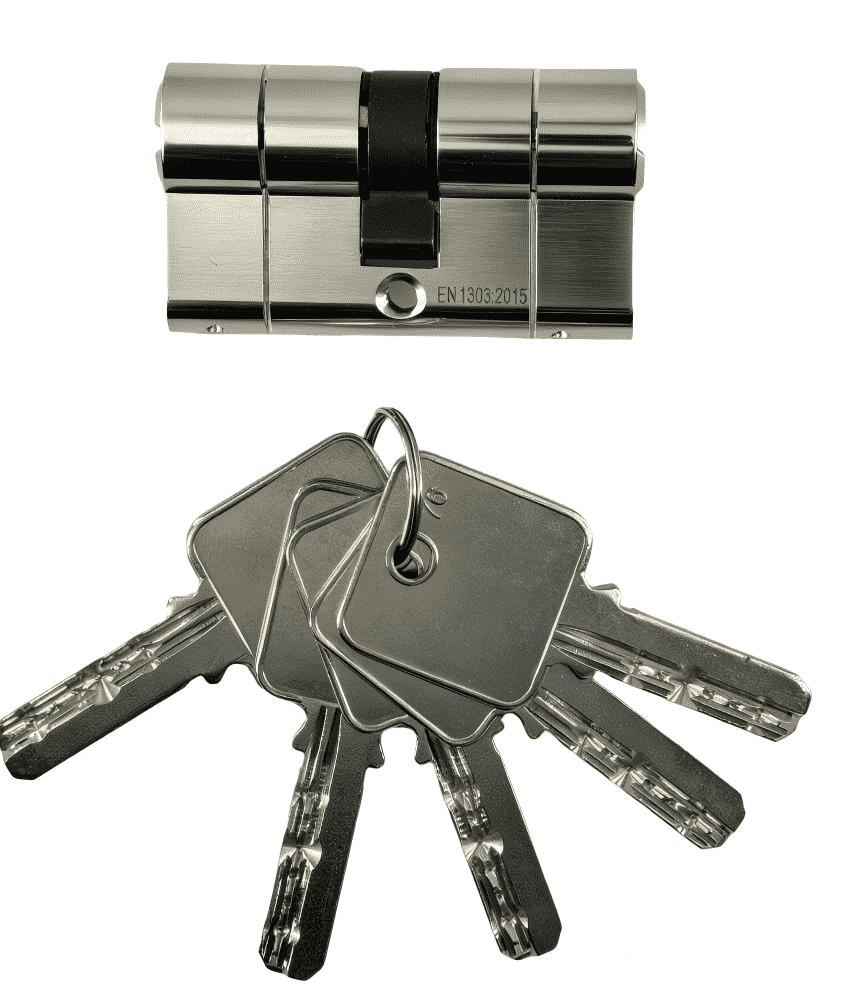
When specifying door hardware for commercial or residential projects in Europe, one overlooked detail can lead to product rejection, project delays, or even insurance disputes — the cylinder standard.
This guide is written for door manufacturers, hardware brands, and professional distributors, providing a comprehensive overview of EN 1303 cylinder standards. It explains the technical requirements, performance classifications, testing methods, and compliance guidelines, helping industry professionals select, evaluate, and implement high-quality cylinders that meet European safety and durability standards.
EN 1303:2015 is not just a “technical number” printed on a datasheet. It defines whether a lock cylinder is truly qualified for durability, corrosion resistance, key security, and mechanical performance under real building use conditions.
For contractors, distributors, and hardware brands, understanding EN 1303 is not about theory — it is about avoiding compliance risks and choosing cylinders that match project security levels.
What is EN 1303:2015
Buyer takeaway: Using EN 1303 classifications during sourcing reduces project risk, prevents quality disputes, and ensures the cylinder selected is suitable for the building type and environment.
For procurement professionals, EN 1303:2015 is not just a technical specification — it is a critical tool for project risk management and product selection. It helps determine whether a lock cylinder will perform reliably over time, withstand environmental challenges, and meet European building and security regulations.
EN 1303:2015 is the latest revision of the lock cylinder performance standard issued by the European Committee for Standardization (CEN). It provides architects, hardware manufacturers, distributors, and project contractors with a measurable and verifiable benchmark for cylinder quality and security. Compared to previous versions, the 2015 update introduces stricter requirements in durability, mechanical strength, key-related security, corrosion resistance, and operational conditions.
For procurement professionals, EN 1303:2015 is not just a technical specification — it is a critical tool for project risk management and product selection. It helps determine whether a lock cylinder will perform reliably over time, withstand environmental challenges, and meet European building and security regulations.
In short, understanding and applying EN 1303:2015 allows door manufacturers, contractors, and distributors to minimize security risks, reduce post-installation issues, and ensure smooth project acceptance, while guaranteeing long-term client satisfaction.
Relationship Between EN 1303, DIN EN 1303, BS EN 1303 and TS 007
In practice, EN 1303 and its country-specific adaptations (BS EN 1303 in the UK, DIN EN 1303 in Germany) define the baseline performance requirements for lock cylinders, including durability, mechanical strength, key security, corrosion resistance, and operational conditions.
TS 007, on the other hand, is a UK-specific high-security standard that builds upon the EN 1303 requirements, focusing on real-world attack resistance such as lock snapping, drilling, picking, and bumping. Compliance with TS 007 ensures enhanced security for residential and commercial doors.
Standard | Issuing Body | Scope / Focus | Certification / Compliance | Application / Purpose |
EN 1303 | CEN (European Committee for Standardization) | General lock cylinder performance: durability, mechanical strength, key security, corrosion resistance, operational conditions | Optional; serves as baseline European standard | Used as technical reference across Europe for lock cylinder selection |
DIN EN 1303 | DIN (Germany) | Same as EN 1303 | Must be certified by German accredited lab for official use | German building projects, engineering compliance |
BS EN 1303 | BSI (UK) | Same as EN 1303 | Must be certified by UK accredited lab | UK construction projects, insurance compliance, Secured by Design recommendation |
TS 007 | BSI (UK) | Enhanced UK security: attack resistance (lock snapping, drilling, picking, bumping) on top of EN 1303 baseline | Must have TS 007 star rating certificate (1★–3★) | UK residential and commercial doors; insurance-required high-security standard |
In summary, DIN EN 1303 and BS EN 1303 share the same technical requirements, with the main difference being that certification must be issued by a locally accredited laboratory. With extensive experience in the lock cylinder industry, Umay is well-equipped to recommend the appropriate standard for your region and specific project needs, ensuring compliance, reliability, and long-term performance.
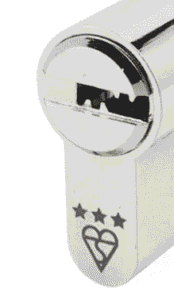
For projects requiring enhanced security, particularly in the UK, TS 007 provides an additional layer of protection, addressing real-world attack scenarios such as lock snapping, drilling, and picking. To learn more about TS 007 and the 3-star euro cylinder classification, please visit our detailed blog: The TS 007 3-Star Euro Cylinder.
Umay can help you select cylinders that not only meet EN 1303 requirements but also comply with TS 007 security standards, giving you peace of mind for high-risk or insurance-sensitive projects.
Umay specializes in mid-to-high-end lock cylinders, particularly those compliant with EN 1303 standards and high-security cylinders certified to TS007. We provide large-scale, reliable supply to door manufacturers, regional brands, and professional distributors worldwide, ensuring that every batch meets strict quality and security requirements.


EN 1303:2015 Lock Cylinder – Key Terms and Definitions
Buyer takeaway: Knowing EN 1303 terminology prevents ordering the wrong cylinder type and ensures full compatibility between cylinder, key, and locking system.
Understanding the key terminology in EN 1303:2015 is essential for anyone specifying or purchasing lock cylinders. Clear knowledge of these terms ensures that you select cylinders that are fully compatible with your keys, meet security requirements, and operate reliably in your projects.
Key definitions include:
- Cylinder – The main device of the lock, usually separate from the lock body, which is operated by a key.

- Cam – A cylinder component that moves to engage the locking mechanism.

- Effective Differ – The unique difference between cylinders of similar design, achieved through movable detainers, ensuring each cylinder is operated only by its designated key.

- Direct Code – Marking on the key that allows its steps to be read directly without additional reference.

- Key – The device that corresponds to the cylinder and mechanically operates it.
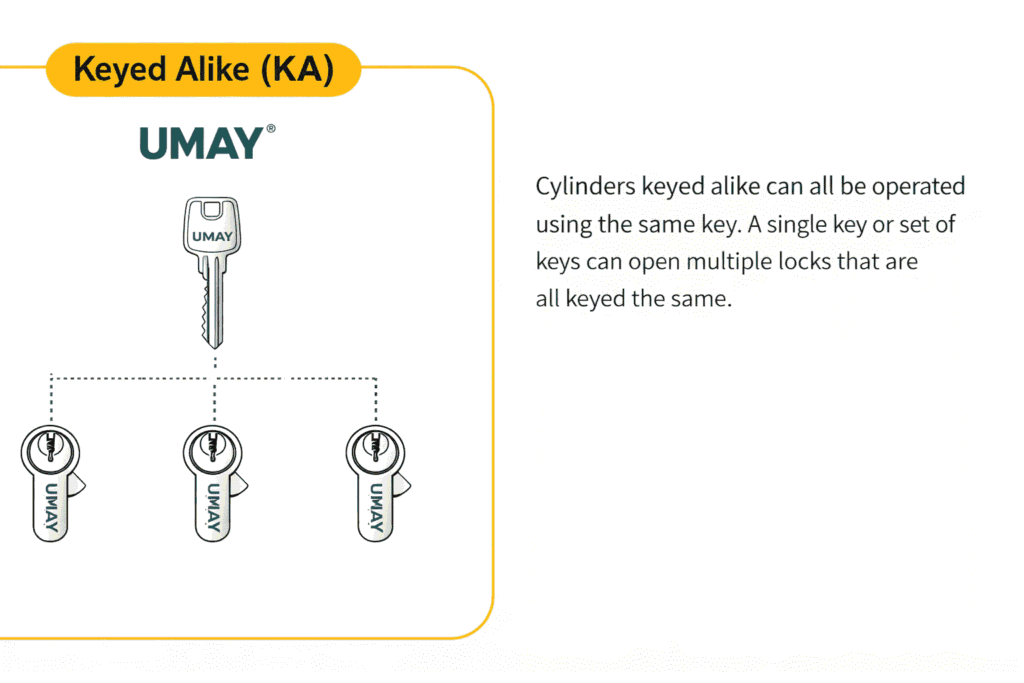
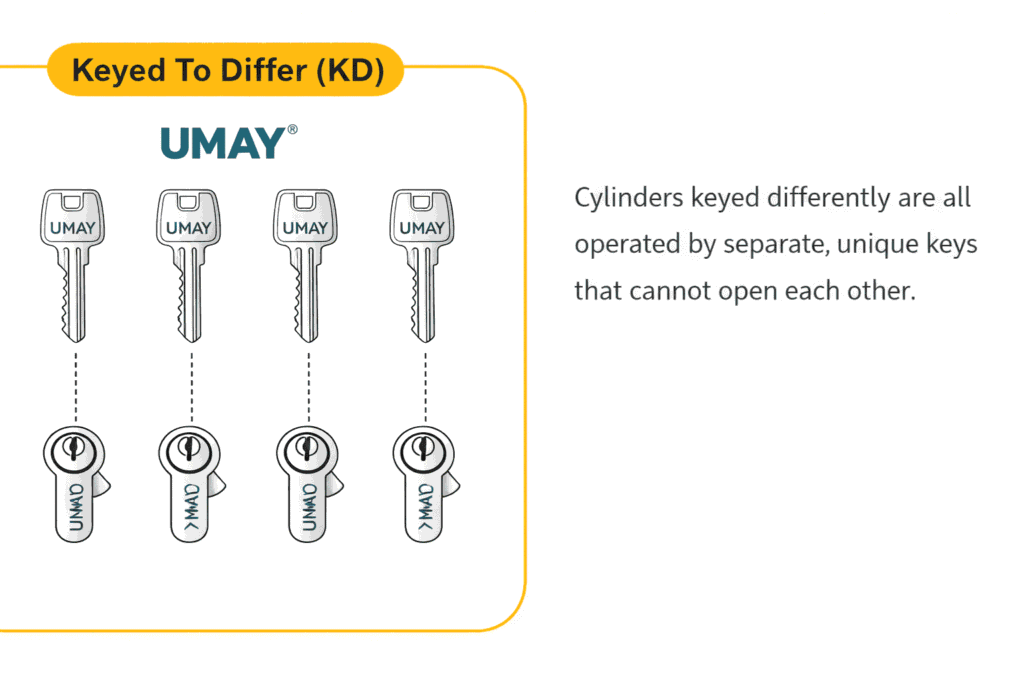
- Keyway – The slot along the plug into which the key is inserted.

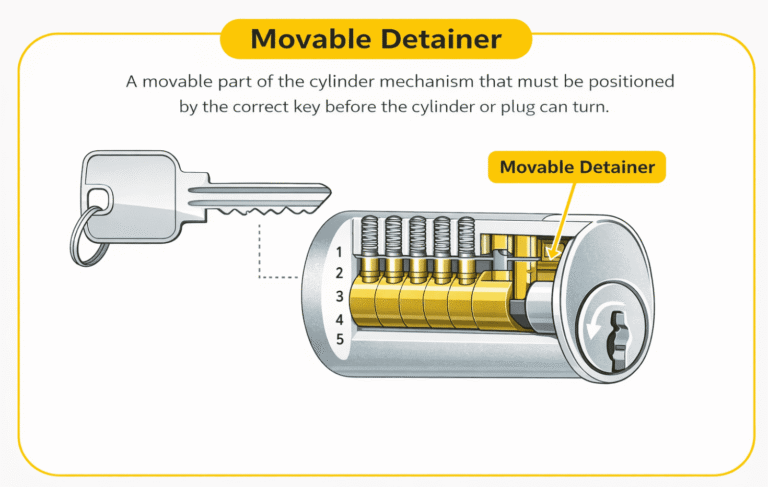
- Movable Detainer – A movable part of the cylinder mechanism that must be positioned by the correct key before the cylinder or plug can turn.
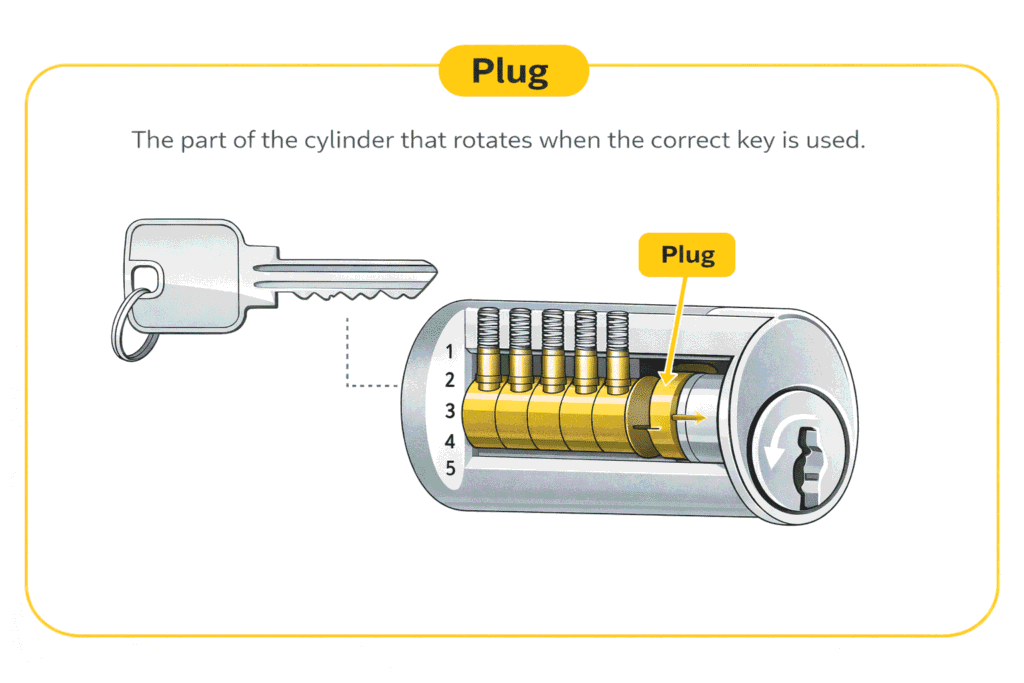
- Plug – The part of the cylinder that rotates when the correct key is used.
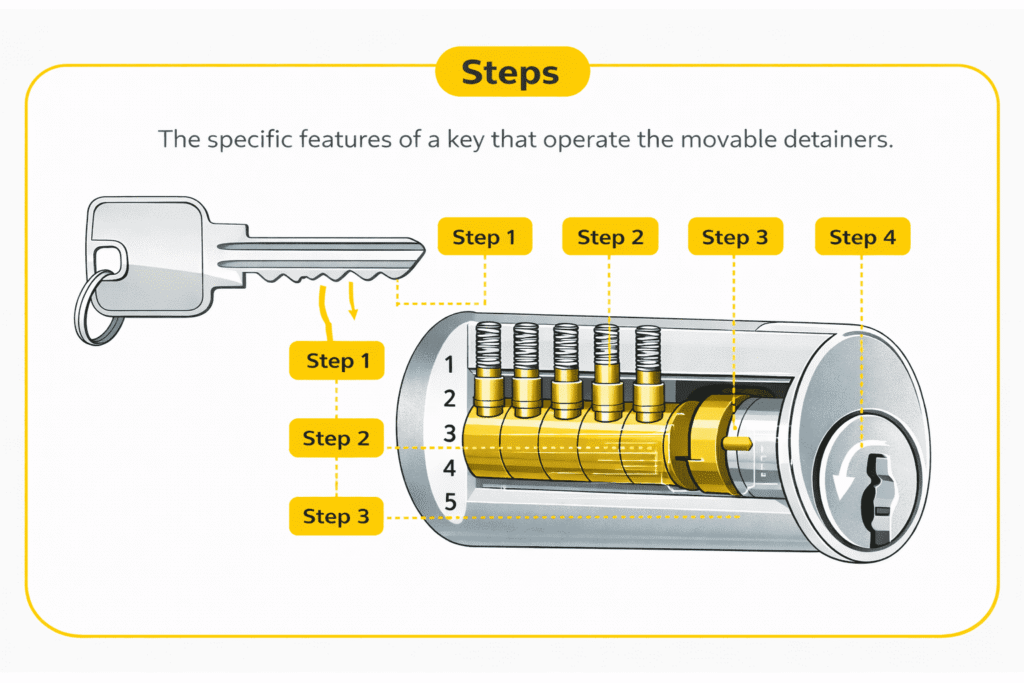
- Steps – The specific features of a key that operate the movable detainers.
By understanding these terms, buyers and project engineers can ensure proper cylinder-key compatibility, maintain security standards, and avoid costly errors in lock selection and installation.
EN 1303:2015 Lock Cylinder Performance and Key Requirements
Buyer takeaway: EN 1303:2015 ensures the cylinder you purchase is not just functional, but tested for long-term durability, security resistance, and environmental reliability.
EN 1303:2015 defines performance and quality requirements for lock cylinders and their original keys commonly used in buildings, ensuring they meet the highest standards of durability, security, corrosion resistance, and operational reliability.
This standard specifies:
- One category of use suitable for standard building locks with a maximum operational torque of 1.2 Nm
- Three durability grades, three fire-resistance grades, and four corrosion-resistance grades, all verified through rigorous performance tests
- Six grades of key-related security based on design, and five grades of attack simulation performance, ensuring the cylinder can resist unauthorized access attempts
Operational reliability across a range of temperatures and protective measures recommended by the manufacturer
Corrosion resistance follows EN 1670, and for cylinders intended for fire or smoke doors, additional fire performance tests are conducted (see Annex A). Manufacturers may declare compliance with these additional requirements where applicable.
Buyers should verify that the chosen cylinders are suitable for their specific project requirements, ensuring long-term security, reliability, and compliance with European standards.
Guide to EN 1303:2015 - Cylinders for Locks Coding System
Buyer takeaway: The EN 1303 coding system lets you judge a cylinder’s durability, security level, and environmental suitability in seconds — instead of relying on marketing descriptions.
The EN 1303:2015 European Standard provides a comprehensive framework for assessing lock cylinders, covering aspects such as durability, fire resistance, and protection against attacks. Products are classified using an 8-digit performance code, with each digit corresponding to a specific attribute tested against standardized criteria. This clear coding system allows buyers and engineers to quickly compare lock cylinder performance and choose the solution that best meets their security and project requirements.
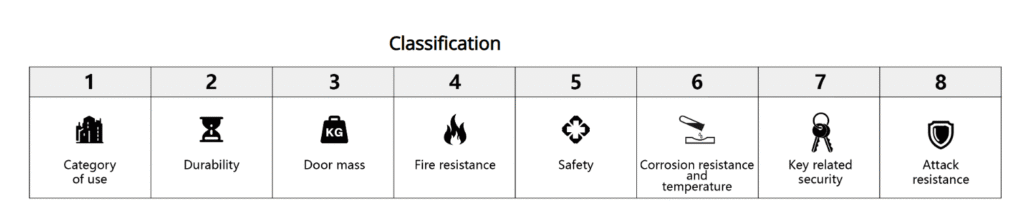
EN 1303:2015 –Digit 1 – Category of Use
The first digit indicates the category of use for the lock cylinder.
Grade 1: Suitable for situations where users are attentive and careful, and the risk of misuse is low. This makes it ideal for residential or low-risk applications where reliability and everyday security are important.
EN 1303:2015 – Digit 2 – Durability
Why this matters:
If you supply doors for public buildings, schools, hospitals, or any high-traffic facility, Durability Grade 6 is often mandatory. Choosing the correct grade helps prevent premature wear, reduces maintenance costs, and ensures long-term reliability for your clients.
| Durability Grade (Digit 2) | Test Cycles | Typical Applications / Notes |
|---|---|---|
| Grade 4 | 25,000 cycles | Designed for standard usage. Suitable for residential doors, private apartments, and other low-frequency operation environments. |
| Grade 5 | 50,000 cycles | For medium-frequency use. Commonly used in offices, schools, and general public buildings where doors are operated regularly. |
| Grade 6 | 100,000 cycles | Intended for high-frequency and intensive use. Ideal for large commercial buildings, hospitals, transport facilities, and industrial projects. |
Durability Tests – Standard Test Cycles

EN 1303:2015 specifies a strict durability testing procedure to verify that lock cylinders perform reliably throughout their rated lifespan.
During testing, the cylinder is operated with a new original key, completing repeated rotations in both clockwise and counterclockwise directions. Each cycle simulates normal use and includes a resistive torque of 0.15 ± 0.05 Nm to ensure proper operation of the cam and deadbolt.
Key points of the test:
- Cycle sequence: Insert key → rotate clockwise → withdraw key → insert key → rotate anticlockwise → withdraw key.
- Cycle speed: 5–12 cycles per minute.
- Torque verification: The cylinder must overcome the specified resistive torque during each rotation.
- Lubrication: Cylinders are lubricated according to the manufacturer’s instructions at the start of the test and after every 5,000 cycles (or as agreed with the testing lab).
- Alternative sequences: If the standard sequence cannot be applied, manufacturers may use an approved equivalent procedure.
- Acceptance criteria: After completing the rated number of cycles, the cylinder must operate smoothly with a new original key, with a maximum torque of 1.5 Nm.
This procedure ensures that cylinders meet their durability grade (Grade 4, 5, or 6) and are suitable for a wide range of projects, from residential doors to high-traffic commercial or industrial applications.
EN 1303:2015-Digit 3 – Door Mass
The third digit in the EN 1303:2015 code represents the door mass grade.
Grade 0: No specific door mass requirement. This means the lock cylinder can be used with doors of any standard weight, providing flexibility for a wide range of residential, commercial, and industrial applications.
EN 1303:2015 –Digit 4 – Fire / Smoke Door Suitability
Why this matters:
For fire doors and smoke-control doors, always select Grade B to meet legal and insurance requirements. Grade A is suitable where only smoke control is needed, and Grade 0 should be limited to standard internal doors without fire or smoke protection needs.
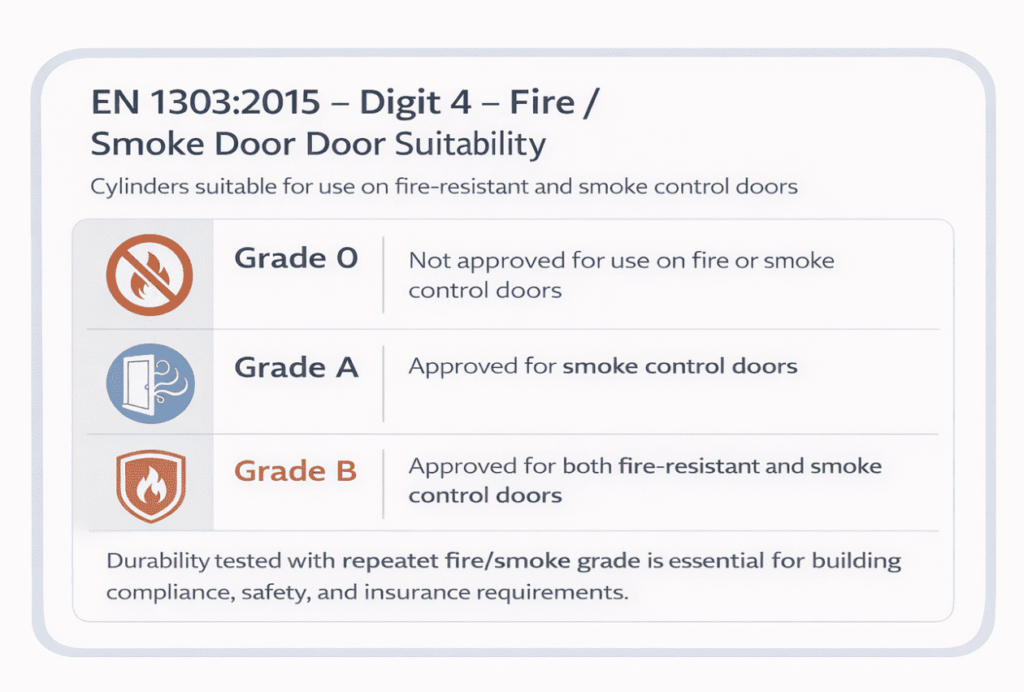
The fourth digit in the EN 1303:2015 code indicates the cylinder’s suitability for use on fire-resistant or smoke control doors. This ensures that the lock complies with safety regulations where fire or smoke protection is required.
Grades of suitability:
- Grade 0: Not approved for use on fire or smoke control door assemblies.
- Grade A: Approved for use on smoke control doors, offering protection in environments where smoke containment is required.
- Grade B: Approved for use on both fire-resistant and smoke control doors, ensuring compliance with fire safety standards and maximum protection.
Selecting a cylinder with the correct fire/smoke grade is essential for building compliance, safety, and insurance requirements. It ensures that doors maintain their fire-resistance and smoke-control performance while providing reliable locking functionality.
Fire / Smoke Door Suitability Detailed Tes
The fourth digit of EN 1303:2015 indicates whether a cylinder is suitable for use on fire-resistant or smoke control doors. Cylinders are classified into three grades based on fire and smoke performance:
Grade 0: Not approved for use on fire or smoke door assemblies.
Grade A: Suitable for use on smoke control doors. To meet this grade, cylinders must comply with one of the following:
- The door assembly incorporating the cylinder passes a smoke test according to EN 1634-3; or
- The cylinder parts that prevent smoke leakage are made of materials with a melting point of at least 300°C.
Grade B: Suitable for use on fire-resistant and smoke control doors. Cylinders in this grade must meet one of the following requirements:
- Be representative of their type and successfully pass a fire test according to EN 1634-1 or EN 1634-2, proving the cylinder’s effect on the fire resistance of the complete door assembly. After the test, operational functionality is not mandatory. Product information must include:
- Reference to the fire test report
- Type of door used for testing (e.g., wood, metal sheet)
- Reference to the fire test report
- The parts responsible for preventing fire spread must be made of materials with a melting point of at least 840°C.
Selecting the correct grade ensures that the cylinder complies with fire and smoke safety standards, protects property and occupants, and meets regulatory requirements for both residential and commercial installations.
EN 1303:2015 –Digit 5 – Safety
EN 1303:2015 defines the safety level of a lock cylinder with a single grade:
- Grade 0: No specific safety requirements.
This means the cylinder does not include additional anti-manipulation features beyond standard mechanical operation. While all EN 1303 cylinders meet basic operational standards, projects requiring advanced protection (against picking, bumping, or unauthorized access) should consider higher-security solutions or TS 007-rated cylinders.
EN 1303:2015 –Digit 6 – Corrosion Resistance & Temperature
Why this matters for buyers:
- If you supply outdoor doors, coastal or industrial facilities, Grade C is often mandatory to prevent premature corrosion and ensure reliable operation in harsh conditions.
- For indoor doors in dry environments, Grade 0 is sufficient and more cost-effective.
- Grade A or B can be chosen depending on humidity exposure or temperature fluctuations, helping optimize durability without overspending.
The sixth digit in EN 1303:2015 indicates the cylinder’s corrosion resistance and operating temperature range. Compared to older standards (which required up to 80 °C), the new EN 1303:2015 sets a more realistic operational range for modern applications: –25 °C to +65 °C.
Grades:
- Grade 0: No corrosion or temperature requirements. Suitable for standard indoor use.
- Grade A: High corrosion resistance; no temperature requirements. Ideal for humid or mildly corrosive environments.
- Grade B: No corrosion requirement; suitable for temperatures from –25 °C to +65 °C. Perfect for doors exposed to varying climates without high corrosion exposure.
- Grade C: High corrosion resistance; suitable for temperatures from –25 °C to +65 °C. Recommended for outdoor or harsh environments, providing maximum durability against weather and corrosion.
Corrosion Resistance & Extreme Temperature Test
Customer takeaway:
- 72-hour salt spray test ensures the cylinder maintains reliable operation in corrosive environments such as coastal or industrial areas.
- Combined with temperature grading (–25 °C to +65 °C), this guarantees long-term durability for both indoor and harsh outdoor applications.
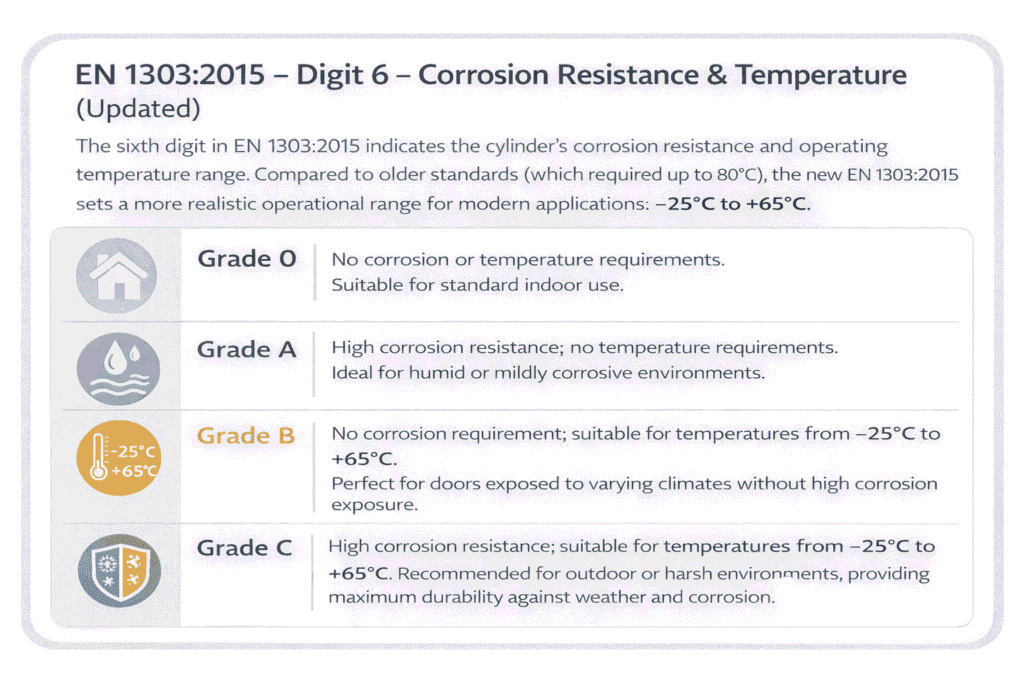
EN 1303:2015 defines rigorous tests to ensure cylinders perform reliably under corrosive conditions and extreme temperatures.
- Corrosion Resistance Test
- The cylinder is tested using a neutral salt spray in accordance with EN 1670, Grade 3 (72 hours).
- The cylinder is mounted as it would be in actual use, following the manufacturer’s instructions.
- After the 72-hour salt spray test, the cylinder must be operable with the correct key, using a maximum torque of 1.5 Nm, within 5 minutes, with the key inserted and rotated as needed.
- Lubrication may be applied before or during the test, following the manufacturer’s guidance.
2. Extreme Temperature Operation Test
- Cylinder and key are stabilized at room temperature (20 ± 5 °C) for at least 24 hours before testing.
- Low Temperature Test: Cylinder is cooled gradually at 20 ± 1 °C per hour to –25 ± 2 °C, maintained for 10–20 minutes. Then the cylinder must operate with its correct key at ambient temperature at least once within 5 attempts over 5 minutes.
- High Temperature Test: Cylinder is heated gradually at 20 ± 1 °C per hour to 65 ± 2 °C, maintained for 10–20 minutes. Then the cylinder must operate with its correct key at ambient temperature at least once within 5 attempts over 5 minutes.
EN 1303:2015 –Digit 7 – Key Related Security
EN 1303:2015 defines six grades of key-related security, which measure how resistant a cylinder is to unauthorized key duplication and mechanical manipulation.
Grade | Minimum number of effective differs | Minimum number of movable detainers | Minimum number of movable detainers | Torque resistance (plug/cylinder) |
1 | 100 | 2 | – | 2.5 Nm |
2 | 300 | 3 | – | 5 Nm |
3 | 15,000 | 5 | No | 15 Nm |
4 | 30,000 | 5 | No | 15 Nm |
5 | 30,000 | 6 | No | 15 Nm |
6 | 100,000 | 6 | No | 15 Nm |
Explanation for customers:
- Effective differs: The number of unique key combinations that can operate the cylinder. Higher numbers = more resistance to unauthorized duplication.
- Movable detainers: Components in the cylinder that only allow the correct key to rotate. More detainers = higher security.
- Direct coding: Whether key coding is directly visible on the key. Most high-security grades do not allow direct coding for safety.
- Torque resistance: Resistance of the plug/cylinder against twisting attacks. Higher Nm = stronger protection.
Customer takeaway:
- Grades 1–2: Suitable for low-security applications, e.g., internal doors or low-traffic areas.
- Grades 3–6: Designed for high-security applications, such as commercial doors, office buildings, or high-risk areas.
- Selecting the correct grade ensures protection against unauthorized key duplication and mechanical attacks, improving overall door security.
EN 1303:2015 – Digit 8 – Attack Resistance
EN 1303:2015 defines five grades of attack resistance, measuring a cylinder’s ability to withstand drilling and mechanical attacks.
Grade | Drilling Resistance | Mechanical Attack Resistance |
0 | None | None |
A | 3 / 5 min | Resistant except plug/cylinder extraction |
B | 5 / 10 min | Resistant except plug/cylinder extraction |
C | 3 / 5 min | Fully resistant |
D | 5 / 10 min | Fully resistant |
Explanation for customers:
- Drilling resistance: Indicates how long the cylinder can withstand a drill attack. Longer resistance times = higher security.
- Mechanical attack resistance: Measures protection against forced entry attempts (excluding or including plug/cylinder extraction depending on grade).
- Grades 0–A: Suitable for standard security applications, mainly indoors or low-risk areas.
- Grades B–D: Designed for high-security applications such as commercial doors, external doors, and high-risk areas.
Customer takeaway:
- Selecting the correct attack resistance grade ensures the cylinder can withstand physical attacks, protecting doors from unauthorized entry.
- Grades C and D provide maximum security, recommended for high-value properties and outdoor installations.
Resistance to Drilling – EN 1303:2015 (Attack Resistance Grades A–D)
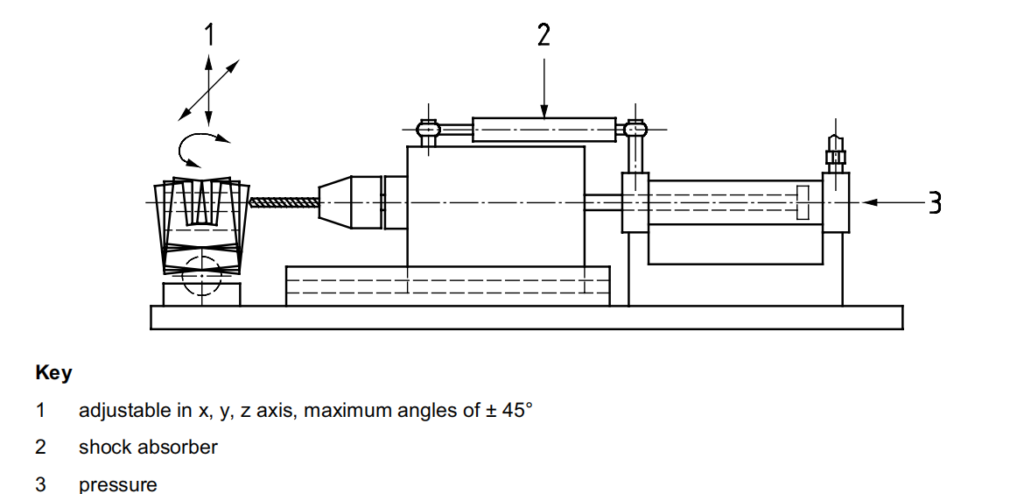
EN 1303:2015 defines strict drilling resistance tests to ensure cylinders withstand unauthorized drilling attacks.
Test Setup:
- The cylinder, including any supplied reinforcements or protective devices, is mounted in a fixture replicating actual installation.
- A 700 W ± 10% drilling machine with a rotational speed of 500–800 r/min is used, applying a constant axial force of 300 ± 25 N to the drill without shocks.
- High-speed steel (HSS) drills, compliant with ISO 10899 or equivalent, with a maximum diameter of 12 mm are used. Up to three drills may be applied per cylinder. Self-centring drills are not permitted.
Test Procedure:
- The drill is positioned at a fixed angle to the cylinder.
- Drilling continues for the maximum net drilling time allowed for the grade, which counts only the time the drill is in contact with the cylinder.
- Total test time starts when the drill first touches the cylinder and includes the time taken to attempt rotating the cylinder.
- During the test, it must be impossible to rotate the cam to the opening position using a torque up to 5 Nm.
Customer takeaway:
- This procedure ensures the cylinder can resist real-world drilling attacks, protecting the lock mechanism and preventing unauthorized entry.
- Grades A–D define increasing levels of resistance, helping you select the right cylinder for high-security doors, commercial facilities, or high-risk areas.
Mechanical Impact Resistance (Chisel / Drop Hammer Test,)

For cylinders tested for mechanical attack resistance:
- A drop hammer weighing 6 ± 0.25 kg is used, dropped from a height of 700 ± 10 mm, to strike a chisel applied to the cylinder.
- The test is stopped immediately if the cylinder shows obvious failure before completing the intended blows.
Additional notes:
- If the cylinder is fitted with security escutcheons or furniture according to EN 1906:2012 Annex A, these must meet the appropriate security class.
- The manufacturer is responsible for providing the test institute with the associated security furniture.
- If the combination of cylinder and security furniture prevents the chisel from being applied, the cylinder is considered to have passed the test.
Customer takeaway:
- Ensures the cylinder can resist direct mechanical attacks using chisels or similar tools.
- Proper security escutcheons enhance protection and can effectively prevent tampering.
Understanding EN 1303:2015 Cylinder Codes – Example: 160B0C5D

Buyer takeaway: Decoding EN 1303 cylinder codes instantly shows a lock’s suitability, durability, security level, and environmental performance — without guessing from marketing claims.
EN 1303:2015 uses an 8-character alphanumeric code to clearly indicate the performance of a lock cylinder. Let’s take “160B0C5D” as an example to explain each digit/letter:
- Digit 1 – Category of Use (1)
- Indicates how carefully the cylinder is expected to be used.
- Grade 1: Suitable for general use with low risk of misuse.
- Indicates how carefully the cylinder is expected to be used.
- Digit 2 – Durability (6)
- Specifies the number of test cycles the cylinder can withstand.
- Grade 6: Rated for 100,000 cycles, ensuring long-term reliability.
- Specifies the number of test cycles the cylinder can withstand.
- Digit 3 – Door Mass (0)
- Indicates compatibility with door weight.
- Grade 0: No specific door mass requirement.
- Indicates compatibility with door weight.
- Digit 4 – Fire/Smoke Door Suitability (B)
- Shows whether the cylinder can be used on fire-resistant or smoke control doors.
- Grade B: Suitable for fire-resistant and smoke control doors.
- Shows whether the cylinder can be used on fire-resistant or smoke control doors.
- Digit 5 – Safety (0)
- Indicates additional safety requirements.
- Grade 0: No special safety requirement.
- Indicates additional safety requirements.
- Digit 6 – Corrosion Resistance / Temperature (C)
- Defines corrosion protection and operational temperature range.
- Grade C: High corrosion resistance and operational temperature from –25 °C to +65 °C.
- Defines corrosion protection and operational temperature range.
- Digit 7 – Key Related Security (5)
- Represents security features related to keys, such as movable detainers and effective differs.
- Grade 5: 30,000 effective differs, 6 movable detainers, torque resistance 15 Nm.
- Represents security features related to keys, such as movable detainers and effective differs.
- Digit 8 – Attack Resistance (D)
- Indicates protection against drilling and mechanical attack.
- Grade D: 5/10 min resistance to drilling and resistance to mechanical attacks, providing high security.
- Indicates protection against drilling and mechanical attack.
Why this matters:
By decoding “160B0C5D,” buyers can instantly understand the cylinder’s performance, compare models objectively, and choose the right cylinder for their security requirements, door type, and environmental conditions.
Why EN 1303 Cylinders Are Superior to Standard Lock Cylinders
Key Takeaway for Customers:
Choosing an EN 1303 cylinder ensures verifiable security, high durability, and compliance with international standards, making it ideal for residential, commercial, or high-security applications. Compared to generic lock cylinders, EN 1303 products provide measurable protection against wear, fire, and attacks, giving you confidence in both safety and long-term investment.
EN 1303:2015 is a European standard that sets strict requirements for performance, security, and durability of lock cylinders and keys. Compared to ordinary or generic lock cylinders, EN 1303 cylinders offer clear advantages:
- Comprehensive Performance Testing
- EN 1303 cylinders undergo rigorous testing for durability, corrosion resistance, fire resistance, temperature tolerance, key security, and attack resistance.
- Ordinary lock cylinders often lack such standardized testing, leaving performance and safety unverified.
- EN 1303 cylinders undergo rigorous testing for durability, corrosion resistance, fire resistance, temperature tolerance, key security, and attack resistance.
- Graded Ratings for Objective Comparison
- Each EN 1303 cylinder is assigned an 8-digit code, representing specific performance levels for durability, fire suitability, corrosion resistance, and attack resistance.
- Standard cylinders usually provide no clear performance grading, making it hard to compare security features objectively.
- Each EN 1303 cylinder is assigned an 8-digit code, representing specific performance levels for durability, fire suitability, corrosion resistance, and attack resistance.
- Enhanced Key Security
- EN 1303 defines six levels of key-related security, including the number of unique key combinations and movable detainers, reducing the risk of unauthorized key duplication.
- Generic cylinders may not control key duplication or provide verifiable key security.
- EN 1303 defines six levels of key-related security, including the number of unique key combinations and movable detainers, reducing the risk of unauthorized key duplication.
- Certified Fire and Smoke Door Compatibility
- Certain EN 1303 cylinders are rated for fire-resistant and smoke-control doors (Grade A/B), ensuring compliance with building safety codes.
- Most ordinary cylinders lack fire or smoke resistance certification, limiting their use in safety-critical doors.
- Certain EN 1303 cylinders are rated for fire-resistant and smoke-control doors (Grade A/B), ensuring compliance with building safety codes.
- Resistance to Drilling and Mechanical Attack
- EN 1303 includes drilling tests, chisel/drop hammer tests, and torque resistance tests, providing verified protection against forced entry.
- Standard cylinders typically offer minimal or untested resistance, leaving doors vulnerable to break-ins.
- EN 1303 includes drilling tests, chisel/drop hammer tests, and torque resistance tests, providing verified protection against forced entry.
- Global Recognition and Certification
- EN 1303 cylinders can be tested to meet DIN, BS, or TS007 standards, making them suitable for international projects.
- Comprehensive Performance Testing
Why Choose Umay for Large‑Scale EN 1303 Lock Cylinder Purchases from China
Buyer takeaway: Choosing the right supplier ensures consistent EN 1303 compliance, reliable delivery, and long-term project security — Umay acts as a trusted partner, not just a vendor..
When sourcing EN 1303:2015 compliant lock cylinders in volume from China, choosing the right supplier is crucial for product quality, delivery reliability, and long‑term performance. Umay stands out as a trusted partner for global buyers due to the following advantages:
Strong Expertise in EN 1303 Standards
Umay has deep technical knowledge and real‑world experience with EN 1303:2015 requirements, including durability, corrosion resistance, fire/smoke door compatibility, key‑related security, and attack resistance. This means you receive products that truly meet certified performance levels — not just marketing claims.
Comprehensive Quality Assurance
All Umay lock cylinders are manufactured under strict quality control and are factory tested before shipment. We provide clear performance grading and test reports so you can confidently match product specifications with your project requirements.
Tailored Solutions for Your Region & Project
Different markets (EU, UK, Middle East) have different compliance needs (e.g., BS EN, DIN EN, TS007). Umay’s team helps you select the right certification packages — whether for fire doors, high‑security installations, or insurance‑compliant solutions.
Scale & Supply Chain Capability
Umay has proven experience fulfilling large volume orders from China, with reliable production capacity, export documentation support, and on‑time delivery for global logistics. That’s essential for construction projects, wholesale distribution, and retail supply chains.
Value‑Driven Price & Long‑Term Support
Our products offer competitive pricing without compromising performance. Beyond shipment, Umay provides technical consultation, warranty support, and after‑sales care to help minimize project risk and total cost of ownership.
In short: When purchasing EN 1303 lock cylinders at scale from China, Umay is not just a supplier — it’s your quality assurance partner, helping you secure the right performance, compliance, and value for your projects.
Share This Story, Choose Your Platform!