
Introduction
In the world of mechanical door locks, attention often goes to the lock body, the handle design, or the cylinder profile.
However, one of the most critical components is also the smallest.
Pins.
Inside every lock cylinder, pins quietly determine whether a door stays locked or opens smoothly.
For door manufacturers, lock brands, and importers, understanding pin systems is essential for security positioning, product differentiation, and long-term customer satisfaction.
As a supplier of mechanical locks, cylinders, door handles, hinges, door viewers, and door closers to global B2B buyers, I have seen firsthand how small pins create big commercial value.
The Role of Pins Inside a Lock Cylinder
Pins are the core working elements of a pin tumbler lock cylinder.
A standard pin tumbler cylinder consists of:
- Key pins (bottom pins)
- Driver pins (top pins)
- Springs
When the correct key is inserted, each key pin aligns precisely at the shear line.
This alignment allows the plug to rotate.
If even one pin is misaligned, rotation is blocked.
This simple mechanism is the foundation of most:
- Euro profile cylinders
- British standard cylinders
- American standard cylinders
Pins directly affect:
- Security level
- Key control
- Smoothness of operation
- Resistance to picking, bumping, and drilling
In large-scale projects—such as residential developments, hotels, or commercial buildings—the performance of these pins directly impacts end-user experience and maintenance cost.
Different Types of Pins Used in Lock Cylinders
Not all pins are the same.
Different pin types serve different security and functional purposes.
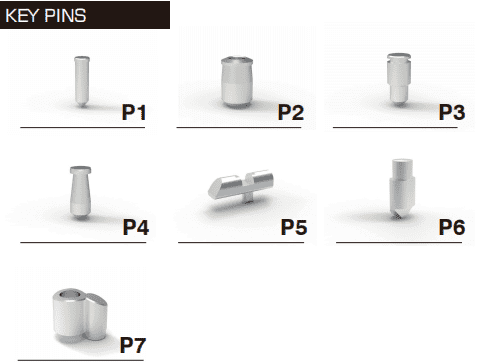
Standard Pins
Standard pins are cylindrical with flat ends.
They are cost-effective and widely used in entry-level mechanical locks.
Best for:
- Basic residential locks
- Interior doors
- Low-risk applications
However, they offer limited resistance to lock picking.
Spool Pins
Spool pins have a narrow waist and wider ends.
They create false feedback during picking.
Advantages:
- Improved pick resistance
- Low additional manufacturing cost
Commonly used in:
- Mid-range Euro cylinders
- Upgraded residential locks
Reference: https://www.art-of-lockpicking.com/security-pins/
Serrated Pins
Serrated pins feature multiple grooves along the body.
Each groove creates a false shear line.
Advantages:
- High resistance to single-pin picking
- Enhanced security without changing cylinder size
Frequently specified by:
- Lock brands
- Importers supplying security-focused markets
Mushroom Pins
Mushroom pins combine features of spool and serrated pins.
They are highly effective against manipulation attacks.
Often used in:
- High-security cylinders
- Commercial and hospitality projects
Anti-Drill Pins
Anti-drill pins are made from hardened steel or alloy.
They protect the cylinder from destructive attacks.
Reference: https://www.securedbydesign.com
These pins are essential for:
- Main entrance doors
- Fire-rated doors
- Insurance-compliant lock systems

Why Customized Pins Matter in Lock Cylinders (Key Focus)
Standard pins are no longer enough in competitive markets.
Customization is where lock manufacturers and buyers create real differentiation.
Why Custom Pins Are Needed
Markets have different requirements:
- Europe prioritizes modular security
- The UK emphasizes certification
- North America values durability
Customized pin systems allow manufacturers to adapt one cylinder platform to multiple markets.
Advantages of Customized Pins
Higher security performance
Custom pin combinations increase key differs and reduce duplication risks.
Improved brand protection
Unique pin structures prevent unauthorized key copying.
Reference: https://www.assaloyds.com/key-control
Better picking resistance
Tailored pin geometry disrupts common attack techniques.
Smoother operation
Pin length, tolerance, and spring force can be optimized for long-term use.
Cost-effective upgrades
Security levels can be increased without redesigning the entire lock body.
For buyers sourcing:
- Mechanical locks
- Cylinders
- Door handles
- Hinges
- Door closers
Customized pin solutions allow a full hardware set to meet market-specific security expectations.
Why Pins Matter More Than Most Buyers Think
Pins directly influence:
- Lock lifespan
- User experience
- After-sales complaints
- Brand reputation
In large projects, replacing cylinders due to poor pin quality costs far more than investing in better pins upfront.
From my experience supplying lock cylinders in bulk, pin customization is one of the highest ROI improvements a buyer can make.
Conclusion
Pins may be small, but their impact is significant.
They control access.
They define security.
They protect brands.
For door factories, lock brands, importers, and building material retailers, understanding pin systems is not technical trivia—it is a commercial advantage.
When combined with well-designed lock bodies, quality door handles, reliable hinges, secure door viewers, and durable door closers, advanced pin systems help create complete, competitive door hardware solutions.
In today’s global market, the smallest components often deliver the biggest value.
Share This Story, Choose Your Platform!